
Ten years ago, we invested in solar and battery. Here's what a decade of operation (and a data goldmine) looks like.
The ongoing adoption of solar power
Solar is now on more than four million Australian rooftops. It is one of the most cost effective ways to generate electricity, especially behind the meter. Add in the federal government's new home battery incentive, and the pattern of electricity demand on the National Electricity Market is dramatically shifting, as storage is batteries are smoothing out price volatility throughout the day and the evening. That's a good thing for everyone.
Our place
Our system: 6.6kW of solar on the roof, with two thirds of them are west facing, and one third facing east. An LG 7kWh battery is installed alongside it. Note how small this seems now 😊
All electric home
At the same time we installed solar and batteries, we went fully electric, by getting rid of gas heating, gas hot water, gas cooking. This all electric home, for three to six months of the year depending on the weather conditions, we are virtually running off grid. Solar covers the house by day, charges the battery, and the battery carries us through the night. Minute by minute there can be grid impots and exports, but essentially over summer the house is independent of the grid.
Generation and use
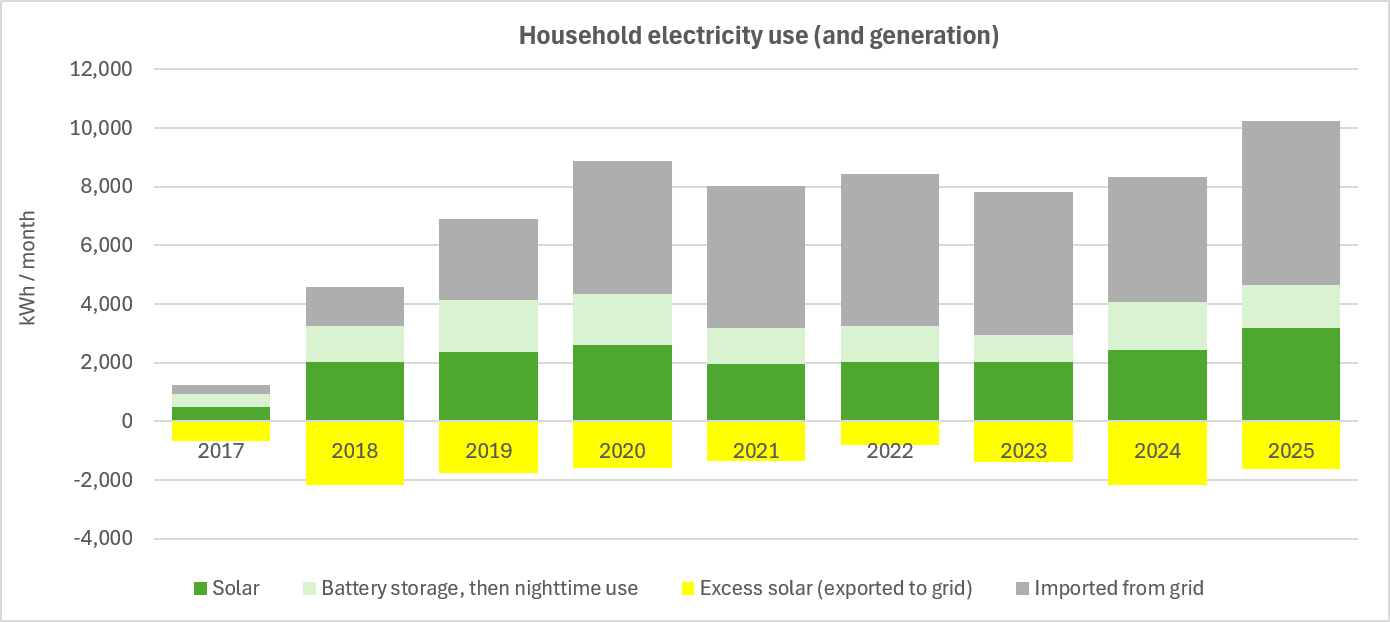
The key result is that over the past decade, 46% of our electricity, for the whole household, has come from the solar and battery system. This would have been 50 to 60% if things had gone our way (I rwill explain more in a sec). But the headline lesson from ten years isn't the hardware. It's the monitoring.
Two years of fixing a fault
Using the SolarEdge app, we caught a fault that was cutting our solar output by 80 to 90 per cent. Same app later flagged when the battery dropped offline. Both were replaced under warranty. The battery was swapped quickly, no fuss. The inverter took two years. It took two years to identify and replace a part, because we were caught between four different parties: the original electrician, the company they were contracted to, the company that sold us the system, and a subcontractor brought in for support. Four parties, and not one of them owned the problem. Only persistence from us as a customer resulted in it being actually fixed.
Battery app to reduce imports
There was a another lesson too. For five or six years, we didn't have a battery optimisation app setting switched on. The app showed us importing power at night when the battery was nearly full, and exporting during the day when it was nearly empty. Which was weird. One setting fixed it. I wish I had found that setting on the app 10 years ago, or someone in the installation had put it on!
Savings
So the cost savings after ten years: over $5,000 saved by cutting gas entirely. Now let’s add what the solar and battery have saved us on electricity itself. The electricity (at assumed cost of 30 cents / kWh) we didn’t have to import from the grid has saved us $9950. Exports aren’t worth much, but they also generated around $700 of us over 10 years. With our EV now in the mix, we're expecting to save another $2,000 to $3,000 a year by avoiding purchasing petrol.
Ten years in, the system still works beautifully. The lesson that stuck wasn't about panels or batteries, it was about watching the data, and not giving up when the support chain falls apart.
What's next
What I find interesting is the path ahead. I’m exploring Vehicle to Grid concepts, alongside Vehicle to Load (i.e. use the car the run the house), and moreso I think the story becomes a community energy or time of use story, not an overall generation story.
But honestly the thing that might make the biggest difference is that we create a thermally efficient and insulated house, that doesn’t need so much winter heating!